
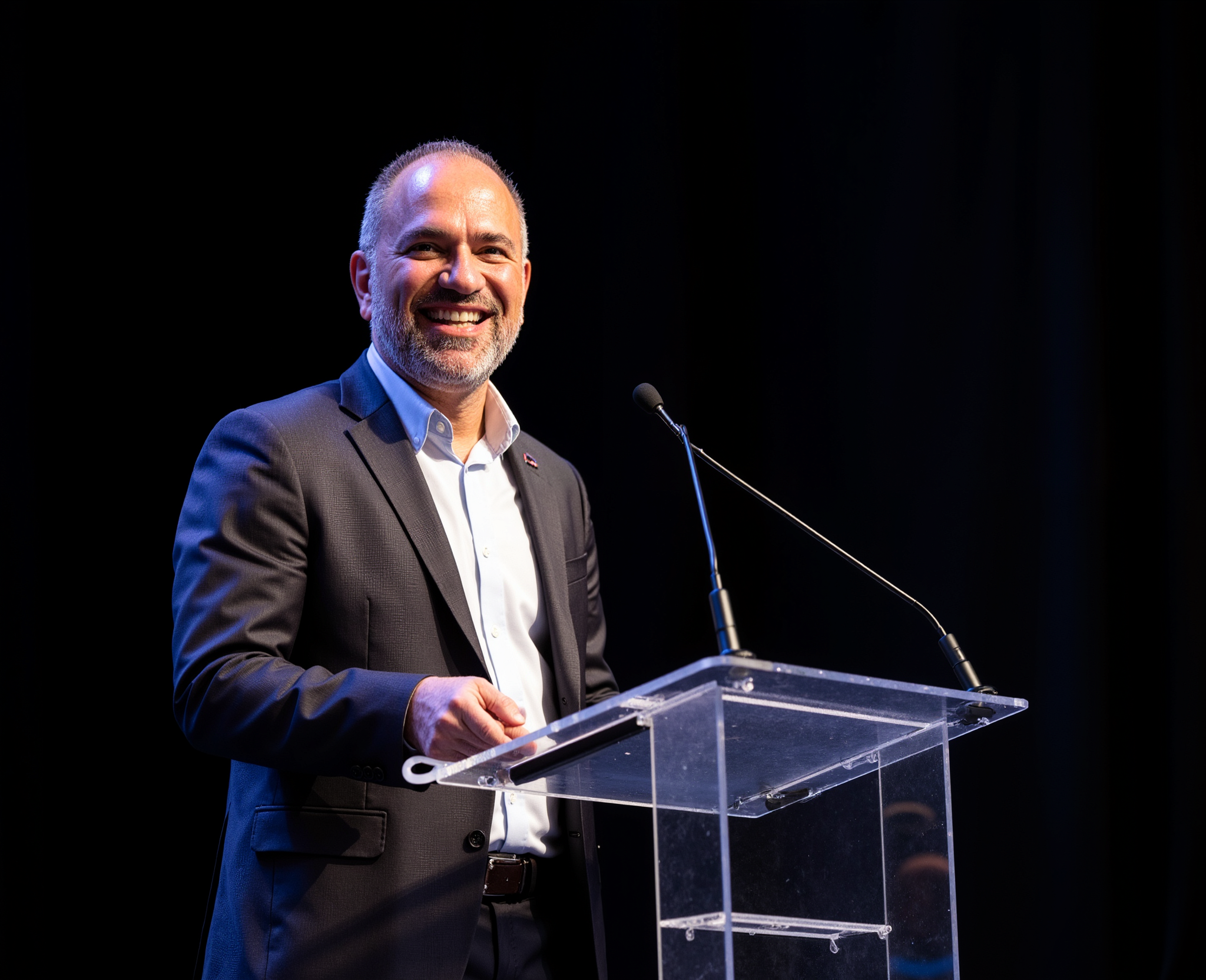
Alain Berinstain, an internationally recognized leader in space research and business, has been named director of the Florida Space Research Consortium (FSRC), a statewide partnership designed to align Florida’s universities around space research, innovation and workforce development.
Berinstain, who is also director of the Florida Space Institute at the University of Central Florida (UCF), has more than 30 years of experience spanning government, industry and academia. Throughout his career, he has led major space initiatives, advanced international collaborations and worked to expand opportunities across the rapidly evolving space sector.
The FSRC is a statewide partnership uniting Florida’s major research universities — Embry‑Riddle Aeronautical University, Florida A&M University, Florida Institute of Technology, Florida International University, Florida State University, UCF, the University of Florida and the University of South Florida — with government, industry and investment partners to pursue objectives that can only be achieved together..
“I am honored to lead the Florida Space Research Consortium at a time of tremendous opportunity for space research and innovation,” said Berinstain, who is a resident of Florida’s Space Coast. “Florida is the world’s busiest and best place to launch to space. I look forward to working with Florida universities, industry and government partners to accomplish together what no individual member of the consortium can achieve on their own and to advance Florida’s leadership in space.”
From 1997 to 2013, Berinstain worked at the Canadian Space Agency, including serving as director of planetary exploration and space astronomy. He has advised companies such as Virgin Galactic and served as Chief Strategy Officer at Space Tango and at CSS Inc.
“Dr. Berinstain brings a unique combination of leadership experience, strategic vision and deep knowledge of the space sector,” said David Norton, vice president for research at the University of Florida and chair of the FSRC board. “He has a proven ability to build partnerships and advance the collaborative mission of the Florida Space Research Consortium.”
Faculty and students at the member universities are advancing a wide range of space research that supports everything from exploration and discovery to practical technologies needed for future missions. Ongoing work across the consortium includes developing smarter spacecraft and satellites; improving propulsion, navigation and communications systems; designing new materials that can withstand the harsh conditions of space; and creating technologies to manufacture, build and operate in space and on the lunar surface.
“Researchers are also focused on using space for the benefit of Earth, addressing human health issues including aging, cancer, Alzheimer’s and Parkinson’s disease,” Berinstain said. “As earthlings prepare to explore the Moon, Mars and beyond, understanding the human side of spaceflight is key. This includes studies of how people, plants and biological systems function in space; efforts to grow food in lunar and Martian conditions; and research in planetary science, astrophysics, space weather and Earth observation. As a team, we can take on bold, new challenges.”